


 Many organizations invest heavily in firewalls, antivirus platforms, and advanced monitoring to stop outside hackers. But even the strongest perimeter can’t protect you from every risk—especially the ones that originate inside your own company.
Employees, contractors, vendors, and partners all have legitimate access to your systems. That access, whether misused intentionally or by accident, can become one of your greatest cybersecurity vulnerabilities. Understanding insider threats—and how to prevent them—is essential to protecting your data, reputation, and bottom line.
What Are Insider Threats?
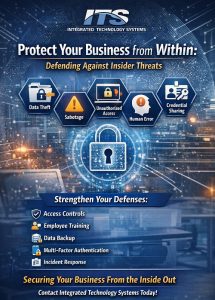
Insider threats come in many forms. Some are malicious, while others are the result of simple mistakes. Here are the most common categories businesses face:
Data Theft
Sensitive information can be copied, downloaded, or shared by someone with internal access. This may happen for personal profit, revenge, or competitive advantage—and it can occur digitally or through stolen devices.
Example: An employee exports confidential customer records and sells them online.
Sabotage
Disgruntled workers or individuals with ulterior motives may intentionally disrupt operations by deleting files, corrupting systems, or locking others out of critical accounts.
Example: A former staff member changes administrative passwords before leaving, bringing operations to a halt.
Unauthorized Access
Sometimes insiders access information they were never meant to see—either deliberately or by accident. This can lead to leaks, compliance violations, and major security incidents.
Example: An employee uses their credentials to view proprietary data and shares it with a competitor.
Negligence & Human Error
Not every threat is intentional. Clicking a phishing link, misplacing a laptop, or sending files to the wrong recipient can expose your entire organization.
Example: Malware is introduced after a team member downloads an infected attachment.
Credential Sharing
Passwords are the keys to your digital kingdom. When they’re shared, reused, or stored insecurely, you lose control over who is really accessing your systems.
Example: An employee logs into company email on a friend’s device and forgets to sign out—later that device is compromised.
Warning Signs to Watch For

Early detection is critical. Be alert for behaviors such as:
- Accessing files outside of normal job responsibilities
- Sudden large downloads or data transfers
- Repeated requests for elevated permissions
- Use of personal or unapproved devices
- Disabling antivirus or security software
- Noticeable changes in behavior, stress levels, or job performance
These red flags don’t always mean malicious intent—but they do signal risk that should be investigated.
Strengthen Your Internal Security
A strong defense requires more than technology alone. Integrated Technology Systems recommends a layered approach:
- Enforce strong password policies and require multi-factor authentication.
- Limit access by role and review permissions regularly.
- Provide ongoing cybersecurity training so employees recognize threats.
- Back up critical data to ensure fast recovery after an incident.
- Create an incident response plan so your team knows exactly what to do.
You Don’t Have to Do It Alone
Managing insider risk can feel overwhelming—especially while running day-to-day operations. Integrated Technology Systems partners with businesses to put the right safeguards in place, from access controls and monitoring to employee education and incident response.
We’ll help you build a security strategy that protects your organization from the inside out. Contact Integrated Technology Systems today to learn how we can monitor for potential threats and respond quickly when it matters most.
Integrated Technology Systems
6 East 45th Street, Suite 400
New York, NY 10017
212-750-5420
https://www.itsnyc.com


