


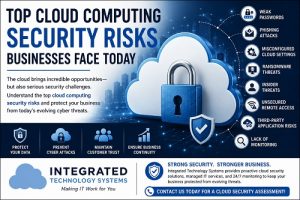
 As businesses continue moving operations to the cloud, they gain greater flexibility, scalability, and efficiency. However, these advantages also introduce new cybersecurity challenges that organizations cannot afford to ignore. Understanding today's cloud computing security risks helps businesses protect sensitive data, maintain customer trust, and reduce the likelihood of costly security incidents.
At Integrated Technology Systems, we help businesses implement proactive cloud security strategies that defend against evolving cyber threats while keeping operations running smoothly. Whether your employees work remotely, collaborate through cloud applications, or store critical business information online, recognizing today's biggest risks is the first step toward stronger protection.
Why Cloud Computing Security Risks Continue to Grow
Modern businesses rely on cloud platforms for everything from email and file sharing to accounting, customer relationship management, and communications. Unfortunately, cybercriminals recognize this dependence and increasingly target cloud environments.
Unlike traditional office networks, cloud environments often include remote workers, mobile devices, third-party applications, and multiple access points. Each connection creates another opportunity for attackers if security measures are not properly managed.
Understanding cloud computing security risks allows organizations to reduce vulnerabilities before they become costly problems.
Weak Passwords Remain One of the Biggest Cloud Security Threats
Despite advances in cybersecurity, weak passwords continue to be one of the leading causes of security breaches.
Many employees still:
- Reuse passwords across multiple accounts
- Choose passwords that are easy to guess
- Share passwords with coworkers
- Store passwords in unsecured locations
These habits make it easier for attackers to gain access to cloud accounts.
Businesses should require:
- Strong password policies
- Multi-factor authentication (MFA)
- Password managers
- Regular credential reviews
These simple improvements significantly reduce exposure to many cloud security threats.
Phishing Attacks Lead to Major Cyber Attacks
Email phishing remains one of the most effective tactics used by cybercriminals.
Attackers often create convincing emails that appear to come from:
- Microsoft 365
- Financial institutions
- Vendors
- Company executives
- IT departments
Employees may unknowingly enter usernames, passwords, or approve fraudulent login requests.
Many successful cyber attacks begin with just one employee clicking a malicious email link.
Ongoing cybersecurity awareness training helps employees recognize suspicious messages before damage occurs.
Misconfigured Cloud Settings Create Serious Cloud Computing Security Risks
Cloud platforms offer extensive customization options. However, incorrect security settings can accidentally expose sensitive business information.
Examples include:
- Publicly accessible file storage
- Overly broad user permissions
- Disabled security alerts
- Improper sharing settings
- Unprotected application programming interfaces (APIs)
These configuration errors often go unnoticed until after data has been compromised.
Routine security assessments help identify and correct these issues before attackers discover them.
Ransomware Continues to Target Cloud Environments
Ransomware remains one of today's fastest-growing cybersecurity concerns.
Although businesses often assume cloud storage protects against ransomware, infected devices can synchronize encrypted files with cloud services.
Without proper backups and recovery planning, organizations may lose access to critical business information.
A layered defense should include:
- Endpoint protection
- Secure backups
- Email filtering
- Continuous monitoring
- Employee education
Together, these defenses help minimize the impact of ransomware-related cyber attacks.
Insider Threats Can Be Just as Dangerous
Not every security incident comes from outside the organization.
Employees, contractors, or former staff members with excessive access permissions may accidentally—or intentionally—expose sensitive information.
Common insider risks include:
- Accidental file sharing
- Improper data handling
- Unauthorized downloads
- Privilege misuse
- Failure to remove inactive accounts
Businesses should regularly review user permissions and remove unnecessary administrative access.
Unsecured Remote Work Increases Cloud Security Threats
Remote work has transformed business operations, but it has also expanded the cybersecurity attack surface.
Employees often connect from:
- Home Wi-Fi networks
- Coffee shops
- Hotels
- Airports
- Personal devices
Without proper security controls, these environments can expose business systems to unauthorized access.
Businesses should implement:
- VPN access
- Multi-factor authentication
- Device encryption
- Endpoint detection
- Mobile device management
These safeguards help protect cloud resources regardless of where employees work.
Third-Party Applications Can Introduce Hidden Risks
Many businesses connect cloud platforms with third-party software to improve efficiency.
While these integrations provide convenience, they can also create new vulnerabilities.
Poorly secured applications may:
- Request excessive permissions
- Store sensitive information
- Introduce software vulnerabilities
- Increase attack opportunities
Businesses should carefully evaluate every third-party application before granting access to company data.
Lack of Continuous Monitoring Delays Threat Detection
Many organizations assume that once cloud security is configured, it no longer requires attention.
Unfortunately, attackers constantly develop new techniques.
Continuous monitoring allows businesses to detect:
- Unusual login attempts
- Suspicious user behavior
- Unauthorized file access
- Malware activity
- Data exfiltration
The sooner suspicious activity is identified, the faster organizations can respond before major damage occurs.
Best Practices for Reducing Cloud Computing Security Risks
Reducing risk requires a proactive cybersecurity strategy rather than reacting after an incident.
Businesses should focus on:
- Enabling multi-factor authentication
- Performing regular security assessments
- Encrypting sensitive data
- Backing up critical information
- Updating software promptly
- Limiting user permissions
- Monitoring cloud activity
- Training employees regularly
- Creating an incident response plan
- Partnering with experienced IT security professionals
These practices work together to strengthen cloud security and reduce the likelihood of successful attacks.
Why Businesses Choose Integrated Technology Systems
Protecting cloud environments requires expertise, ongoing monitoring, and proactive planning. At Integrated Technology Systems, we help businesses strengthen their cybersecurity with comprehensive managed IT services and cloud security solutions.
Our services include:
- Cloud security assessments
- Managed cybersecurity
- Network monitoring
- Endpoint protection
- Microsoft 365 security
- Multi-factor authentication deployment
- Backup and disaster recovery
- Employee cybersecurity awareness training
- Compliance support
- 24/7 proactive monitoring
We help businesses reduce risk while maintaining secure, reliable access to their cloud systems.
Protect Your Business Before an Attack Happens
Today's cloud technologies offer tremendous opportunities for growth and efficiency, but they also require strong security practices. Understanding cloud computing security risks allows businesses to stay ahead of evolving cloud security threats and reduce their exposure to costly cyber attacks.
A proactive approach to cybersecurity not only protects your data but also strengthens customer confidence, supports compliance, and keeps your business operating without interruption.
Frequently Asked Questions
- What are the most common cloud computing security risks?
The most common risks include phishing attacks, weak passwords, ransomware, misconfigured cloud settings, insider threats, and unsecured remote access.
- How can businesses reduce cloud security threats?
Businesses can improve security by enabling multi-factor authentication, encrypting data, training employees, limiting user access, performing regular security assessments, and continuously monitoring cloud environments.
- Are small businesses targeted by cyber attacks?
Yes. Small and medium-sized businesses are frequently targeted because attackers often view them as having fewer cybersecurity defenses than larger organizations.
- Does using a cloud provider automatically make my business secure?
No. Cloud providers secure the infrastructure, but businesses remain responsible for protecting user accounts, data, devices, access permissions, and security configurations.
- How can Integrated Technology Systems help improve cloud security?
Integrated Technology Systems provides managed IT services, cloud security assessments, cybersecurity monitoring, endpoint protection, backup and disaster recovery, compliance support, and employee security training to help businesses reduce cyber risks and strengthen their overall security posture.
Don't wait until a cyberattack disrupts your business. Integrated Technology Systems provides proactive cloud security, managed IT services, cybersecurity monitoring, backup and disaster recovery, and expert guidance to help protect your organization. Contact us today to schedule a cloud security assessment and discover how we can reduce your business's cybersecurity risks before they become costly problems.
Integrated Technology Systems
6 East 45th Street, Suite 400
New York, NY 10017
212-750-5420
https://www.itsnyc.com


