


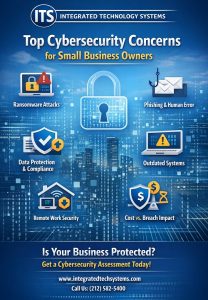
 Cybersecurity is no longer just a concern for large corporations. Today, small business cybersecurity is one of the most important operational priorities for companies of every size. From ransomware attacks to data breaches, cyber threats are increasing in frequency and sophistication — and small businesses are often the primary targets.
At Integrated Technology Systems, we work with small and mid-sized businesses that are trying to balance growth, profitability, and protection. Many owners know cybersecurity matters, but they aren’t always sure where their biggest risks lie.
This guide outlines the main cybersecurity concerns small business owners face. In upcoming articles, we’ll explore each topic in depth and provide practical, actionable solutions.
Why Small Businesses Are Prime Targets
Contrary to popular belief, hackers often target small businesses precisely because they assume defenses are weaker. Limited IT resources, outdated systems, and lack of formal security policies make smaller organizations appealing entry points.
Cybercrime doesn’t discriminate by size — it looks for vulnerability.
Ransomware remains one of the top cybersecurity concerns for small businesses. These attacks encrypt your data and demand payment for its release. Construction companies, professional services firms, healthcare offices, and retailers have all been affected.
Common worries include:
- How vulnerable are our current systems?
- Do we have secure backups?
- How long would we be down if attacked?
- Would cyber insurance actually cover us?
Downtime alone can cost thousands of dollars per day — not including reputational damage.
Most cyber incidents begin with a simple email. Phishing attacks trick employees into clicking malicious links or sharing login credentials.
Small business owners often ask:
- How do we prevent employees from falling for scams?
- Do we need formal cybersecurity training?
- Is multi-factor authentication enough?
Human error remains the leading cause of data breaches. Technology must be paired with ongoing training and monitoring.
3. Data Protection & Compliance Risks
Many businesses collect sensitive data — customer records, payment information, contracts, or employee details. Failing to protect this data can result in regulatory fines and legal liability.
Key concerns include:
- Are we compliant with industry regulations?
- Is our data encrypted?
- Who has access to sensitive information?
- Are remote employees secure?
Data protection is no longer optional. Even one breach can permanently damage customer trust.
4. Outdated Systems & Software
Another major small business cybersecurity concern is aging infrastructure. Unsupported operating systems, outdated firewalls, and unpatched software create open doors for attackers.
Business owners often struggle with:
- When should we upgrade systems?
- Is cloud migration safer?
- How do we balance cost with security?
Modern cybersecurity requires proactive maintenance, not reactive repairs.
With remote and hybrid work models becoming standard, protecting company networks is more complex than ever.
Common questions include:
- Are home networks secure?
- Should we use VPNs?
- How do we protect mobile devices?
- What policies should we implement?
Without clear remote access controls, businesses expand their attack surface significantly.
6. Cost of Cybersecurity vs. Cost of a Breach
One of the most frequent concerns about outsourcing cybersecurity is cost. Many small businesses hesitate to invest in managed IT services because they see it as an expense rather than risk mitigation.
However, the cost of:
- Ransom payments
- Legal fees
- Regulatory fines
- Downtime
- Reputation damage
Often far exceeds the cost of proactive cybersecurity protection.
Outsourcing cybersecurity to a trusted provider gives businesses access to enterprise-level protection without the expense of hiring a full internal IT team.
7. Lack of a Clear Cybersecurity Strategy
Many small business owners admit they do not have a documented cybersecurity plan. They may have antivirus software and a firewall — but no formal risk assessment, response plan, or backup strategy.
This creates uncertainty:
- What happens if we’re breached?
- Who do we call?
- How do we recover?
- How do we notify customers?
A clear cybersecurity roadmap removes guesswork and reduces panic during an incident.
Why Outsourcing Cybersecurity Makes Sense
For most small businesses, building an in-house cybersecurity department is unrealistic. Outsourcing cybersecurity provides:
- 24/7 monitoring
- Threat detection
- Data backup & disaster recovery
- Employee security training
- Compliance guidance
- Ongoing system updates
Integrated Technology Systems specializes in helping businesses strengthen their cybersecurity posture while staying focused on operations and growth.
The Bottom Line: Cybersecurity Is Business Protection
Cybersecurity is no longer an IT issue — it’s a business survival issue.
The main cybersecurity concerns small business owners face all point to one conclusion: proactive protection is far less costly than reactive recovery.
This article serves as the foundation for our upcoming in-depth guides, where we’ll break down each risk area and provide detailed solutions tailored to small businesses.
Protect Your Business Before a Problem Happens
If you’re unsure whether your company is properly protected, now is the time to act.
Integrated Technology Systems offers cybersecurity assessments designed specifically for small businesses. We’ll evaluate your current systems, identify vulnerabilities, and build a customized protection plan that fits your budget and operational needs.
Don’t wait for a breach to discover your weaknesses.
Contact Integrated Technology Systems today to schedule your cybersecurity consultation and take the first step toward stronger, smarter protection.
Integrated Technology Systems
6 East 45th Street, Suite 400
New York, NY 10017
212-750-5420
https://www.itsnyc.com


