


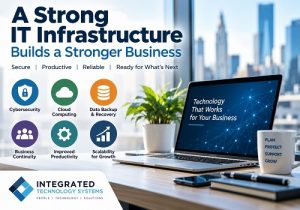
 A strong IT infrastructure gives a business the technology foundation it needs to operate securely, efficiently, and reliably. It includes computers, networks, servers, cloud services, cybersecurity tools, data storage, backups, software, and the systems employees use every day.
For many businesses, technology is no longer simply a support function. Email, customer records, financial information, cloud applications, communications, and daily operations all depend on reliable technology.
That means an outdated or poorly managed IT environment can affect almost every part of a company.
Integrated Technology Systems helps businesses evaluate, manage, and improve their technology so their IT infrastructure can support both current operations and future growth.
What Is Business IT Infrastructure?
Business IT infrastructure is the combination of hardware, software, networks, cloud platforms, security systems, and services that keep a company's technology operating.
A modern infrastructure may include:
- Computers and mobile devices
- Business networks and Wi-Fi
- Cloud applications and file storage
- Email and communication systems
- Cybersecurity software
- Firewalls and network security
- Data backup and recovery systems
- Access controls and multi-factor authentication
- Business applications
- Remote-work technology
These systems should work together rather than operate as separate pieces of technology.
How Does Strong IT Infrastructure Improve Productivity?
Employees lose valuable time when computers are slow, applications do not communicate properly, networks are unreliable, or technical problems repeatedly interrupt their work.
A properly designed IT environment helps reduce these disruptions.
For example, cloud applications can make information accessible to authorized employees regardless of whether they are working in the office or remotely. Automated processes can also reduce repetitive manual work.
Reliable technology allows employees to spend more time serving customers and completing important business tasks instead of troubleshooting technology.
Why Is Cybersecurity Part of IT Infrastructure?
Cybersecurity should be built into a company's technology environment rather than added after a problem occurs.
Businesses may face threats involving phishing, compromised passwords, malware, ransomware, unauthorized account access, and data theft.
A secure infrastructure can combine several layers of protection. These may include multi-factor authentication, endpoint protection, firewalls, access controls, email security, software updates, encryption, and employee cybersecurity training.
However, installing security software alone is not enough. Businesses also need to know who has access to sensitive information and whether those permissions are still appropriate.
Integrated Technology Systems can help businesses identify technology risks and develop security measures appropriate for their operations.
Why Are Data Backup and Recovery Important?
A strong IT infrastructure also prepares a company for unexpected disruptions.
Important files can be lost because of hardware failure, human error, cyberattacks, software problems, or other incidents. Simply having a backup does not necessarily mean a business can quickly recover its information.
Businesses should know what information is being backed up, how frequently backups occur, where copies are stored, and how information will be restored.
Regular testing is especially important. A backup that cannot be successfully restored provides little protection during an emergency.
For this reason, backup and recovery should be part of a broader business continuity strategy.
Can Your Technology Grow With Your Business?
Technology that works for a five-person company may not be appropriate when the business grows to 20, 50, or 100 employees.
Growth can create new technology requirements involving user accounts, software licenses, cloud storage, cybersecurity, network capacity, remote access, and data management.
Planning ahead makes expansion easier.
A scalable IT infrastructure allows businesses to add employees, locations, applications, and services without repeatedly rebuilding their technology environment.
How Does IT Infrastructure Affect Customer Service?
Customers may never see a company's servers, network equipment, or cybersecurity systems, but they can experience the results.
Slow systems can delay customer responses. Network problems can interrupt communications. Lost information can create service problems. A cybersecurity incident can also affect customer confidence.
Reliable technology helps employees access information quickly, communicate effectively, and respond to customers without unnecessary technical delays.
In this way, IT infrastructure can directly influence the customer experience.
Where Do Managed IT Services Fit?
Many small and midsize businesses do not have the resources to employ specialists for networking, cybersecurity, cloud computing, backup, software management, and technical support.
Managed IT services provide access to technology expertise without requiring businesses to build a large internal IT department.
An IT provider can monitor systems, maintain technology, address security concerns, manage backups, troubleshoot problems, and help a company plan future technology investments.
Integrated Technology Systems works with businesses to understand their operations first and then determine which technologies and services can best support those needs.
Build IT Around Your Business
A strong IT infrastructure should do more than keep computers running.
It should protect business information, support employees, reduce unnecessary downtime, prepare the company for disruptions, and make it easier to adopt new technology as business requirements change.
Technology also continues to evolve. Cloud computing, cybersecurity threats, automation, artificial intelligence, and remote collaboration are changing how companies operate.
Businesses that regularly evaluate their infrastructure are better positioned to adapt without allowing outdated technology to become an obstacle.
Frequently Asked Questions
What does IT infrastructure include?
IT infrastructure generally includes computers, networks, servers, cloud platforms, software, cybersecurity systems, data storage, backups, and the technology services required to manage them.
Why is IT infrastructure important for a small business?
Small businesses depend on technology for communication, customer information, financial records, daily operations, and productivity. Reliable infrastructure helps keep those systems available and protected.
How often should a business review its IT infrastructure?
Businesses should review their technology regularly and whenever significant changes occur, such as adding employees, opening locations, adopting new software, moving systems to the cloud, or experiencing security concerns.
Can managed IT services improve an existing IT environment?
Yes. A managed IT provider can evaluate existing systems, identify weaknesses, recommend improvements, provide ongoing support, and help develop a technology plan based on the company's needs.
Strengthen Your Business Technology
Your technology should help your business operate—not become another obstacle your employees have to overcome.
Integrated Technology Systems can evaluate your current IT environment and help identify opportunities to improve reliability, cybersecurity, data protection, business continuity, and long-term scalability.
Call Integrated Technology Systems at 212-750-5420 to discuss your business IT needs.
Integrated Technology Systems
6 East 45th Street, Suite 400
New York, NY 10017
212-750-5420
https://www.itsnyc.com


