


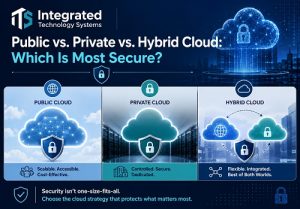
 Choosing the right cloud environment is an important cybersecurity decision for any business. Public, private, and hybrid cloud models can all provide reliable protection, but each one offers a different level of control, flexibility, cost, and responsibility.
The most secure option is not always the one with the most advanced technology. Instead, the best choice depends on your data, compliance requirements, workforce, applications, and internal IT resources. Integrated Technology Systems helps businesses compare their options and develop secure cloud environments that support both daily operations and long-term growth.
What Are Cloud Services?
Cloud services allow businesses to access computing resources through the internet instead of relying entirely on equipment located inside the office. These resources may include:
- Data storage
- Business applications
- Virtual servers
- Data backup
- Disaster recovery systems
- Cybersecurity tools
- Collaboration platforms
- Remote desktop environments
A cloud provider maintains much of the underlying infrastructure. However, the customer still has responsibilities related to passwords, user permissions, application settings, data management, and employee security practices.
This arrangement is often called the shared responsibility model. The provider protects the cloud infrastructure, while the customer must secure how its organization uses that infrastructure.
Understanding the Public Cloud
A public cloud uses computing infrastructure owned and operated by an outside provider. Multiple organizations share the provider’s physical infrastructure, although their systems and data remain logically separated.
Popular business applications, hosted email platforms, online storage systems, and software-as-a-service tools often operate in public cloud environments.
Benefits of the Public Cloud
Public environments are popular because they are flexible and cost-effective. Businesses can add or remove resources without purchasing new servers or maintaining a large data center.
Other advantages include:
- Lower upfront equipment costs
- Fast deployment
- Easy scalability
- Access from multiple locations
- Automatic infrastructure updates
- Built-in redundancy
- Support for remote employees
Major providers also invest heavily in physical security, network protection, monitoring, and system maintenance. As a result, a properly configured public environment can be highly secure.
Security Challenges of the Public Cloud
The greatest risks often come from configuration mistakes rather than weaknesses in the provider’s infrastructure. A storage folder that is accidentally made public, an administrator account without multifactor authentication, or an employee with excessive permissions can expose sensitive information.
Businesses may also have less control over where systems operate and how infrastructure changes are managed. Therefore, public environments require strong access policies, continuous monitoring, and careful configuration.
Is a Private Cloud More Secure?
A private cloud provides computing resources dedicated to a single organization. It may operate in the company’s own facility, in a third-party data center, or through a managed hosting provider.
Because the environment is not shared with unrelated organizations, a private cloud gives the business greater control over infrastructure, security settings, applications, and data storage.
Benefits of a Private Cloud
Private environments may be a strong choice for organizations with strict security or compliance requirements. They can be customized to support specific operational policies, industry regulations, and application needs.
Potential benefits include:
- Dedicated computing resources
- Greater control over security settings
- Customized access policies
- More control over data location
- Support for specialized legacy applications
- Easier integration with certain internal systems
Healthcare organizations, financial companies, government contractors, manufacturers, and other highly regulated businesses may benefit from this additional level of control.
Security Challenges of a Private Cloud
Greater control also means greater responsibility. The organization must maintain hardware, install updates, monitor threats, configure firewalls, manage backups, and replace aging equipment.
A private environment is not automatically safer simply because it is dedicated to one organization. If the business lacks qualified IT professionals or fails to update its systems, the environment may become less secure than a well-managed public platform.
Private infrastructure may also cost more to build and maintain. Businesses need dependable staffing, documented procedures, and ongoing security investments to protect it effectively.
How Does a Hybrid Cloud Work?
 A hybrid cloud combines public cloud resources with private infrastructure. Applications and data can remain in different environments based on their security, performance, compliance, or operational requirements.
For example, a company might keep sensitive customer records in a dedicated environment while using public platforms for email, collaboration, file sharing, or temporary computing capacity.
A hybrid model can provide a balance between control and flexibility.
Security Benefits of a Hybrid Cloud
A hybrid cloud allows a business to decide where each workload belongs. Highly sensitive systems can remain in a controlled environment, while less sensitive applications can use scalable public resources.
This approach can provide several advantages:
- Flexible workload placement
- Better support for regulatory requirements
- Scalable computing resources
- Improved business continuity
- Support for gradual cloud migration
- Reduced dependence on one environment
- Greater control over critical information
A company can also use public resources for backup or disaster recovery while continuing to operate important applications in its private environment.
Integrated Technology Systems can help organizations classify their data and determine which systems should remain private, move to a public platform, or operate across both environments.
Hybrid Cloud Security Challenges
Although a mixed environment provides flexibility, it can also increase complexity. The company must protect data as it moves between systems and maintain consistent security policies across multiple platforms.
Common challenges include:
- Inconsistent user permissions
- Limited visibility between environments
- Integration weaknesses
- Unsecured data transfers
- Multiple security management tools
- Configuration errors
- More complicated compliance reporting
Without centralized monitoring, an IT team may struggle to identify suspicious activity across the entire network. Businesses should use unified identity management, encryption, multifactor authentication, endpoint protection, and continuous security monitoring.
Which Cloud Model Is Most Secure?
No single cloud model is the most secure for every organization. Security depends on how the environment is designed, configured, maintained, and monitored.
A public environment may be the best option for a small business that needs strong infrastructure without maintaining its own servers. A private environment may be more suitable for an organization that requires complete control over regulated or highly sensitive data. A hybrid model may work best for a company that needs both control and scalability.
The following factors should guide the decision:
Type of Data
Businesses that manage financial records, medical information, intellectual property, or other sensitive data may need tighter control over where that information is stored.
Compliance Requirements
Industry regulations may influence data location, access controls, retention policies, encryption, and reporting requirements.
Internal IT Resources
A dedicated environment requires skilled professionals who can manage updates, security tools, hardware, backups, and monitoring. Companies without these resources may benefit from managed cloud support.
Business Growth
A rapidly growing company may need a platform that can scale without significant hardware purchases. Public and mixed environments can often provide additional resources quickly.
Remote Access Needs
Organizations with remote or mobile employees need secure access controls, device protection, multifactor authentication, and reliable collaboration tools.
Disaster Recovery Goals
The chosen environment should support dependable backups, system redundancy, recovery testing, and a documented business continuity plan.
Cloud Security Best Practices for Every Environment
Regardless of which model a company chooses, several practices can reduce cybersecurity risks.
Businesses should:
- Require multifactor authentication
- Use strong role-based access controls
- Encrypt sensitive information
- Review user permissions regularly
- Remove inactive accounts promptly
- Install security updates
- Monitor systems continuously
- Protect employee devices
- Maintain secure backups
- Test disaster recovery procedures
- Train employees to recognize cyber threats
- Document the company’s security responsibilities
It is also important to understand what the provider protects and what remains the customer’s responsibility. Assuming that the provider handles every part of cybersecurity can create serious security gaps.
Should Your Business Choose a Hybrid Cloud?
A mixed environment may be a good fit when a business has a combination of sensitive systems, modern applications, remote employees, and changing technology needs. It can also help companies modernize gradually instead of moving every system at once.
However, the environment must be planned carefully. Businesses need consistent security policies, centralized monitoring, secure system integrations, and clear ownership of every application and data set.
The right design should make the company easier to protect rather than adding unnecessary complexity.
Build a More Secure Cloud Strategy
Public, private, and hybrid cloud environments can all support strong cybersecurity when they are designed and managed correctly. The most secure solution is the one that matches your operational needs, protects your most valuable information, and receives continuous professional oversight.
Integrated Technology Systems provides professional cloud services, cybersecurity guidance, system monitoring, data protection, and ongoing IT support. Our team can evaluate your current technology, identify security gaps, and recommend an environment that supports your organization’s goals.
Contact Integrated Technology Systems today to discuss a secure, scalable cloud strategy for your business.
Integrated Technology Systems
6 East 45th Street, Suite 400
New York, NY 10017
212-750-5420
https://www.itsnyc.com


